
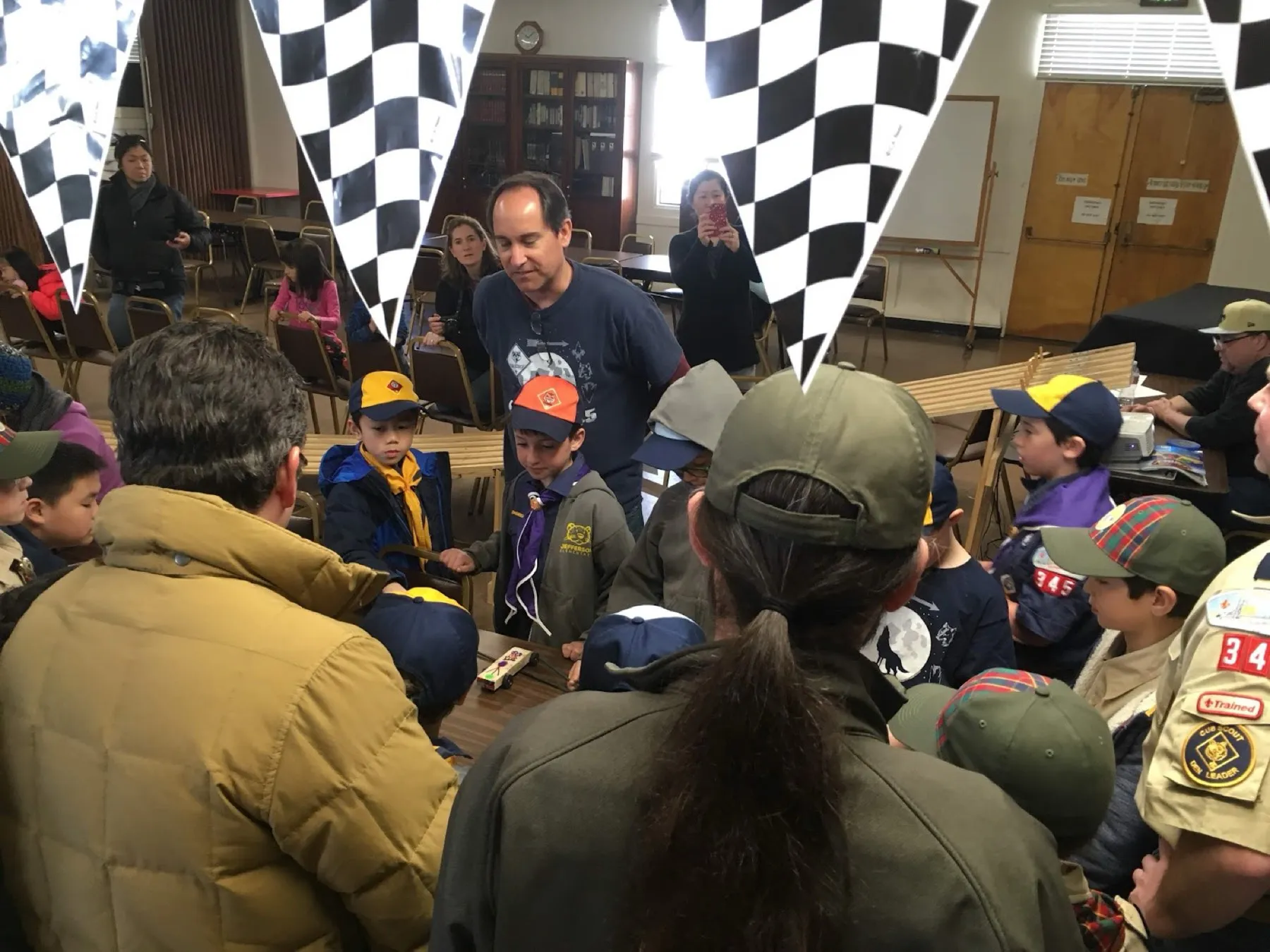
March, on a four-lane track
The Pinewood Derby
A pine block, four wheels, four axles and three weeks of evenings at the kitchen table. In March it all comes down a four-lane track.
Only one car can be fastest, so we hand out a lot of other awards — Scoutiest, Most Edible, That Does Not Look Like a Car. Nearly every car goes home with something, and the scouts vote on most of them.
How much should you help?
A good rule: your kid should feel like they did all the work. They’ll be prouder of the messy, wobbly car they built than the gorgeous one you built for them.
How race day works
- Your child checks in. The car is weighed, inspected and assigned a number.
- Once a car is weighed and accepted, only race officials and the cub may touch it.
- Cubs race in groups of twelve, mostly by den. A heat takes 20–25 minutes and every child races at least six times, once in each lane.
- The three fastest cars from each heat move on to a final round to decide the speed winners.
- Scout voting for the design awards happens throughout the day.
- The Family League races after the scouts have finished.
Design awards — voted by the scouts
- That Does Not Look Like a Car
- Scoutiest car
- Most colorful car
- Most hilarious car
- Dreamiest / most magical car
- Most historic car
- Most futuristic car
- Most animal-like car
- Car with the most hard miles on it
- Stealthiest car
- Most edible car
- Most friendly car
- Scout's Choice
Chosen by leaders and race results
- 1st, 2nd and 3rd place — fastest cars
- Cubmaster Favorite
- Family League Design Choice
- Demolition Derby Car — the car that leaves its lane the most
The rules
Dimensions
- Overall width no more than 2¾ inches, so it doesn’t interfere with the car next to it.
- 1¾ inches clearance between the wheels, so it runs on the centre rail.
- ⅜ inch clearance underneath the body, so it doesn’t rub on the track.
- Must fit under the timing gate at the end of the track — about 4 inches high.
Weight
- No more than 141.75 grams (5 ounces if the scale doesn’t show grams).
- The official race scale used at check-in is final.
Wood, wheels and axles
- The official pinewood derby kit block must be used.
- The front edge should be straight or U-shaped so it rests easily on the starting pin. Avoid V shapes.
- Official BSA wheels only. They may not be altered except for light sanding to remove seams and imperfections. Hubs may be painted. The alternate-color official BSA wheels are fine.
- The axle nails from your kit must be used. You may polish them to remove seams, and you may bend them.
- All four wheels must touch the surface of the scale at weigh-in.
Not allowed
- No lubrication of any kind, wet or dry. This means no graphite.
- No riding on fewer than four wheels.
- No wheel bearings, washers or bushings. No springs.
- No starting devices, propulsion or additional power — the car must be freewheeling.
- No loose material of any kind, such as lead shot.
- Pre-made car kits violate the spirit of the event.
Not sure whether something is allowed?
Check with race officials at info@pack345sf.org before race day. Officials reserve the right to ask for modifications or withhold cars that don’t meet the spirit of the rules. Once the competition begins, cars may only be repaired under an official’s supervision.
How to actually win
You win by moving exactly five ounces of car downhill with as little friction as possible — friction being the air, the track, and your wheels and axles.
- Smooth axles and an aerodynamic shape. If you can’t settle on a design, a simple wedge works well.
- Weight the back, not the front — a rear-weighted car gets a gravity boost as the slope changes. Aim for most of the weight about an inch ahead of the rear axle.
Designing the car
Print a blank template, let your scout draw on it, then cut it out and tape it to the block. An adult cuts that shape into the wood; the scout sands, paints and accessorizes.
Looking for ideas?
The Family League
A separate round of racing for adults, siblings and other non-scouts. Same rules, but the car is entirely your own.